 Add to Chrome
 Add to Firefox
 Add to Edge
Beyond Euclidean Proximity: Repairing Latent World Models with Horizon-Matched Trajectory Reachability Metrics
May 21, 2026
Latent world models can contain the state needed for control, yet their terminal-cost interface can expose the planner to the wrong decision-relevant information. In common latent MPC, candidate sequences are ranked by Euclidean distance between predicted terminal and goal latent states; this assumes that raw latent distance weights reachability-relevant variables correctly. We propose trajectory reachability metrics (TRM), a post-hoc terminal-ranking method for fixed latent world models. TRM trains a small pairwise head from logged trajectory structure and uses it as a replacement or hybrid cost; the encoder, dynamics, sampler, optimizer, and evaluation manifests remain fixed. The key design choice is horizon-aware supervision: the metric is trained on broad, balanced temporal separations to match the long-horizon terminal candidate ranking problem. On a hard TwoRoom benchmark, raw latent planning with LeWorldModel (LeWM) reaches 7.0% success, while full-horizon TRM reaches 97.0%; shuffled temporal-label controls stay at 0.0%. The same recipe improves a PLDM baseline from 32.7% to 84.0% across three seeds, and a short-horizon TRM variant reaches only 35.0% with the 100,000 pair budget. In TwoRoom, we provide mechanistic evidence for why TRM works: XY position is linearly decodable (R^2=0.998), yet raw latent MSE misranks candidates; the XY-probe rowspace accounts for less than 1% of terminal-goal latent MSE but carries most candidate-quality signal; and SCSA audits show that TRM improves the ordering and selected endpoint seen by the planner. On PushT go50/go75, TRM-style task-state metrics improve SCSA ranking and selected final distance more cleanly than closed-loop success, motivating auxiliary hybrid costs in continuous manipulation. TRM is the planner-facing repair, and audits explain when terminal reachability metrics should replace or augment raw latent proximity.

Beyond Mode Collapse: Distribution Matching for Diverse Reasoning
May 19, 2026On-policy reinforcement learning methods like GRPO suffer from mode collapse: they exhibit reduced solution diversity, concentrating probability mass on a single solution once discovered and ceasing exploration of alternative strategies. We show this stems from reverse KL minimization's mode-seeking behavior, which reinforces the first high-reward trajectory found rather than maintaining a distribution over multiple diverse solutions. We propose DMPO (Distribution-Matching Policy Optimization), which prevents mode collapse through principled approximation of forward KL minimization. DMPO constructs a group level target distribution over sampled trajectories proportional to their rewards, then aligns the policy distribution to this target. This provides mode-covering behavior without requiring sampling from the intractable global target distribution, enabling sustained exploration throughout training. We validate DMPO on NP-hard combinatorial optimization, where exponentially many feasible solutions exist but only a few approach optimality, an ideal testbed for evaluating exploration. DMPO achieves 43.9% Quality Ratio on text-based NP-Bench (vs. GRPO's 40.1%) and 43.1% on vision-based NP-Bench (vs. 38.4%), demonstrating 9% and 12% relative improvements respectively. These gains generalize to mathematical reasoning (+2.0%) and out-of-domain tasks (+2.3%), showing that diversity-preserving training enhances general reasoning capabilities across modalities. Our work establishes distribution matching as a practical, principled approach to preventing mode collapse in on-policy RL, with consistent quality improvements demonstrating sustained exploration across diverse reasoning tasks.
Escaping the Context Bottleneck: Active Context Curation for LLM Agents via Reinforcement Learning
Apr 13, 2026Large Language Models (LLMs) struggle with long-horizon tasks due to the "context bottleneck" and the "lost-in-the-middle" phenomenon, where accumulated noise from verbose environments degrades reasoning over multi-turn interactions. To address this issue, we introduce a symbiotic framework that decouples context management from task execution. Our architecture pairs a lightweight, specialized policy model, ContextCurator, with a powerful frozen foundation model, TaskExecutor. Trained via reinforcement learning, ContextCurator actively reduces information entropy in the working memory. It aggressively prunes environmental noise while preserving reasoning anchors, that is, sparse data points that are critical for future deductions. On WebArena, our framework improves the success rate of Gemini-3.0-flash from 36.4% to 41.2% while reducing token consumption by 8.8% (from 47.4K to 43.3K). On DeepSearch, it achieves a 57.1% success rate, compared with 53.9%, while reducing token consumption by a factor of 8. Remarkably, a 7B ContextCurator matches the context management performance of GPT-4o, providing a scalable and computationally efficient paradigm for autonomous long-horizon agents.
COINBench: Moving Beyond Individual Perspectives to Collective Intent Understanding
Mar 22, 2026Understanding human intent is a high-level cognitive challenge for Large Language Models (LLMs), requiring sophisticated reasoning over noisy, conflicting, and non-linear discourse. While LLMs excel at following individual instructions, their ability to distill Collective Intent - the process of extracting consensus, resolving contradictions, and inferring latent trends from multi-source public discussions - remains largely unexplored. To bridge this gap, we introduce COIN-BENCH, a dynamic, real-world, live-updating benchmark specifically designed to evaluate LLMs on collective intent understanding within the consumer domain. Unlike traditional benchmarks that focus on transactional outcomes, COIN-BENCH operationalizes intent as a hierarchical cognitive structure, ranging from explicit scenarios to deep causal reasoning. We implement a robust evaluation pipeline that combines a rule-based method with an LLM-as-the-Judge approach. This framework incorporates COIN-TREE for hierarchical cognitive structuring and retrieval-augmented verification (COIN-RAG) to ensure expert-level precision in analyzing raw, collective human discussions. An extensive evaluation of 20 state-of-the-art LLMs across four dimensions - depth, breadth, informativeness, and correctness - reveals that while current models can handle surface-level aggregation, they still struggle with the analytical depth required for complex intent synthesis. COIN-BENCH establishes a new standard for advancing LLMs from passive instruction followers to expert-level analytical agents capable of deciphering the collective voice of the real world. See our project page on COIN-BENCH.
Self-Alignment Resonant Beam Empowers Beamforming without Estimation and Control for 6G IoT
Dec 09, 2025The integration of communication, sensing, and wireless power transfer (WPT) is a cornerstone of 6G intelligent IoT. However, relying on traditional beamforming imposes prohibitive overheads due to complex channel state information (CSI) estimation and active beam scanning, particularly in dynamic environments. This paper presents a comprehensive review of the radio frequency resonant beam system (RF-RBS), a native physical-layer paradigm that circumvents these limitations. By deploying retro-directive antenna arrays (RAA) at transceivers, RF-RBS establishes a self-sustaining cyclic electromagnetic loop. This mechanism inherently enables self-aligning, high-gain beamforming through positive feedback, eliminating the reliance on digital CSI processing. We analyze the system's architecture and its capability to support high-efficiency WPT, robust communication, and millimeter-level passive positioning. Finally, we evaluate the implementation challenges and strategic value of RF-RBS in latency-sensitive 6G scenarios, including unmanned systems and industrial automation.
OPT-BENCH: Evaluating LLM Agent on Large-Scale Search Spaces Optimization Problems
Jun 12, 2025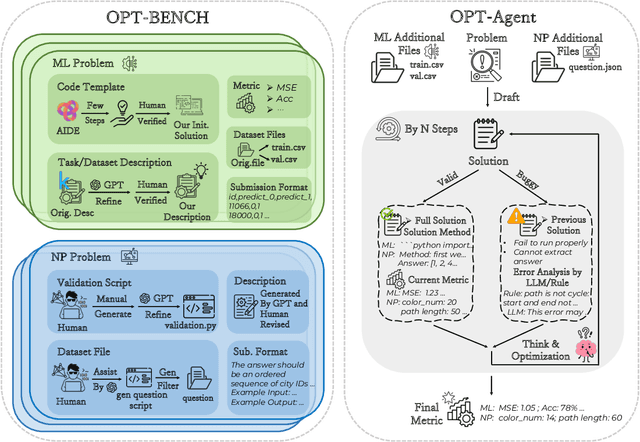
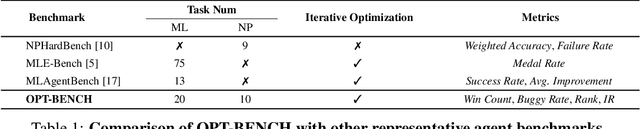
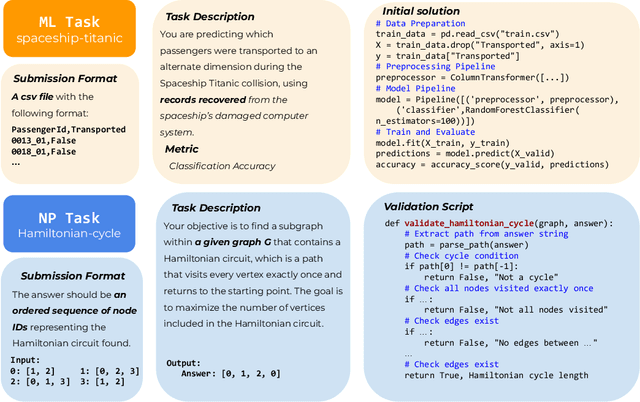
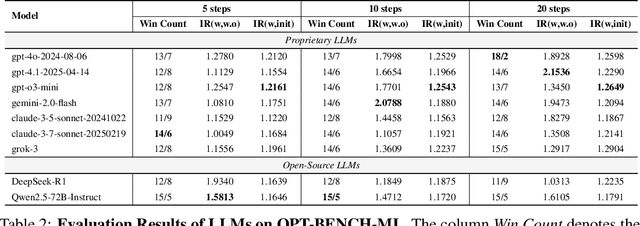
Large Language Models (LLMs) have shown remarkable capabilities in solving diverse tasks. However, their proficiency in iteratively optimizing complex solutions through learning from previous feedback remains insufficiently explored. To bridge this gap, we present OPT-BENCH, a comprehensive benchmark designed to evaluate LLM agents on large-scale search space optimization problems. OPT-BENCH includes 20 real-world machine learning tasks sourced from Kaggle and 10 classical NP problems, offering a diverse and challenging environment for assessing LLM agents on iterative reasoning and solution refinement. To enable rigorous evaluation, we introduce OPT-Agent, an end-to-end optimization framework that emulates human reasoning when tackling complex problems by generating, validating, and iteratively improving solutions through leveraging historical feedback. Through extensive experiments on 9 state-of-the-art LLMs from 6 model families, we analyze the effects of optimization iterations, temperature settings, and model architectures on solution quality and convergence. Our results demonstrate that incorporating historical context significantly enhances optimization performance across both ML and NP tasks. All datasets, code, and evaluation tools are open-sourced to promote further research in advancing LLM-driven optimization and iterative reasoning. Project page: \href{https://github.com/OliverLeeXZ/OPT-BENCH}{https://github.com/OliverLeeXZ/OPT-BENCH}.
FDMA-Based Passive Multiple Users SWIPT Utilizing Resonant Beams
May 24, 2025The rapid development of IoT technology has led to a shortage of spectrum resources and energy, giving rise to simultaneous wireless information and power transfer (SWIPT) technology. However, traditional multiple input multiple output (MIMO)-based SWIPT faces challenges in target detection. We have designed a passive multi-user resonant beam system (MU-RBS) that can achieve efficient power transfer and communication through adaptive beam alignment. The frequency division multiple access (FDMA) is employed in the downlink (DL) channel, while frequency conversion is utilized in the uplink (UL) channel to avoid echo interference and co-channel interference, and the system architecture design and corresponding mathematical model are presented. The simulation results show that MU-RBS can achieve adaptive beam-forming without the target transmitting pilot signals, has high directivity, and as the number of iterations increases, the power transmission efficiency, signal-to-noise ratio and spectral efficiency of the UL and DL are continuously optimized until the system reaches the optimal state.
Duplex Self-Aligning Resonant Beam Communications and Power Transfer with Coupled Spatially Distributed Laser Resonator
May 08, 2025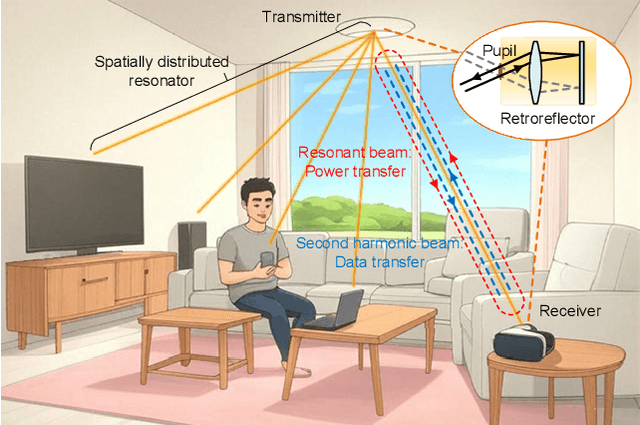
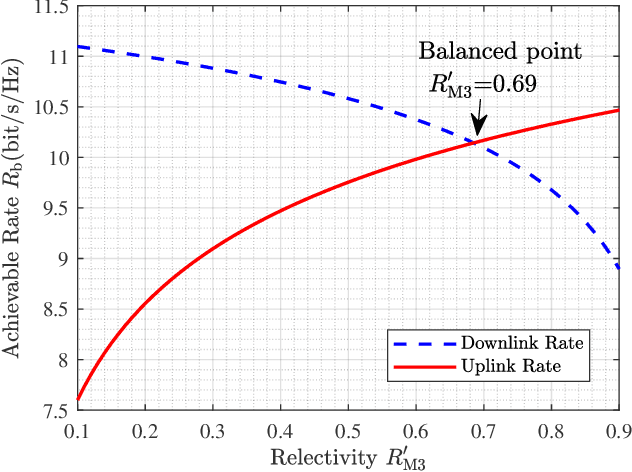
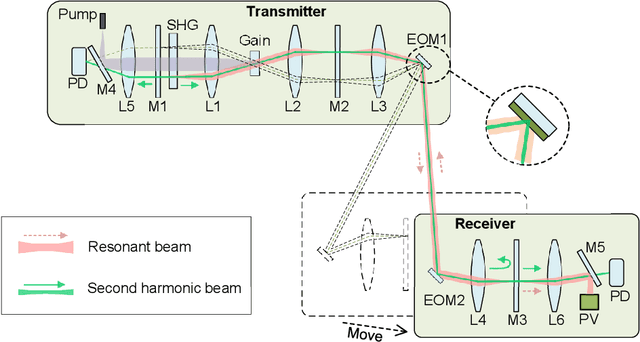
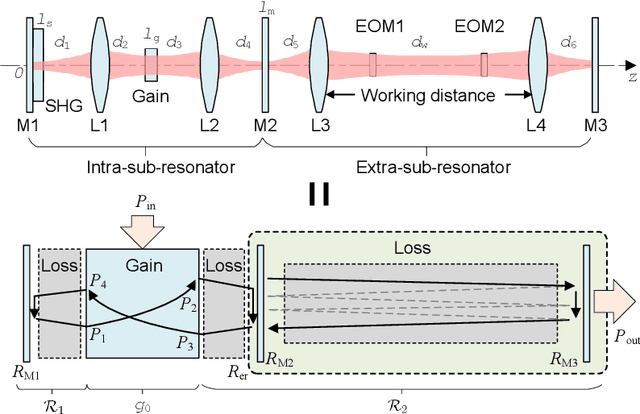
Sustainable energy supply and high-speed communications are two significant needs for mobile electronic devices. This paper introduces a self-aligning resonant beam system for simultaneous light information and power transfer (SLIPT), employing a novel coupled spatially distributed resonator (CSDR). The system utilizes a resonant beam for efficient power delivery and a second-harmonic beam for concurrent data transmission, inherently minimizing echo interference and enabling bidirectional communication. Through comprehensive analyses, we investigate the CSDR's stable region, beam evolution, and power characteristics in relation to working distance and device parameters. Numerical simulations validate the CSDR-SLIPT system's feasibility by identifying a stable beam waist location for achieving accurate mode-match coupling between two spatially distributed resonant cavities and demonstrating its operational range and efficient power delivery across varying distances. The research reveals the system's benefits in terms of both safety and energy transmission efficiency. We also demonstrate the trade-off among the reflectivities of the cavity mirrors in the CSDR. These findings offer valuable design insights for resonant beam systems, advancing SLIPT with significant potential for remote device connectivity.
Squeeze Out Tokens from Sample for Finer-Grained Data Governance
Mar 18, 2025Widely observed data scaling laws, in which error falls off as a power of the training size, demonstrate the diminishing returns of unselective data expansion. Hence, data governance is proposed to downsize datasets through pruning non-informative samples. Yet, isolating the impact of a specific sample on overall model performance is challenging, due to the vast computation required for tryout all sample combinations. Current data governors circumvent this complexity by estimating sample contributions through heuristic-derived scalar scores, thereby discarding low-value ones. Despite thorough sample sieving, retained samples contain substantial undesired tokens intrinsically, underscoring the potential for further compression and purification. In this work, we upgrade data governance from a 'sieving' approach to a 'juicing' one. Instead of scanning for least-flawed samples, our dual-branch DataJuicer applies finer-grained intra-sample governance. It squeezes out informative tokens and boosts image-text alignments. Specifically, the vision branch retains salient image patches and extracts relevant object classes, while the text branch incorporates these classes to enhance captions. Consequently, DataJuicer yields more refined datasets through finer-grained governance. Extensive experiments across datasets demonstrate that DataJuicer significantly outperforms existing DataSieve in image-text retrieval, classification, and dense visual reasoning.
Bursting Filter Bubble: Enhancing Serendipity Recommendations with Aligned Large Language Models
Feb 19, 2025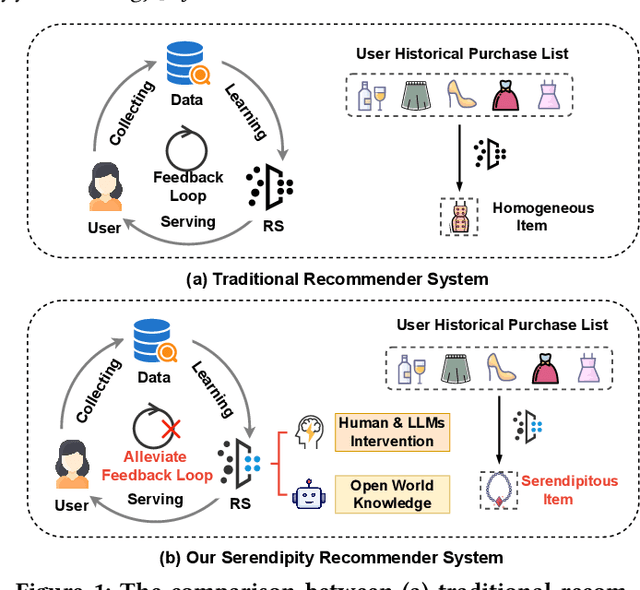
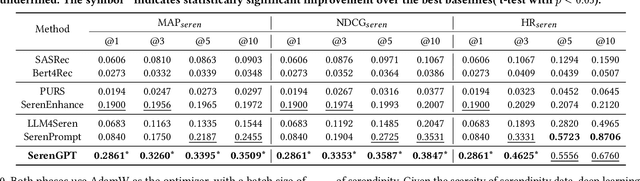
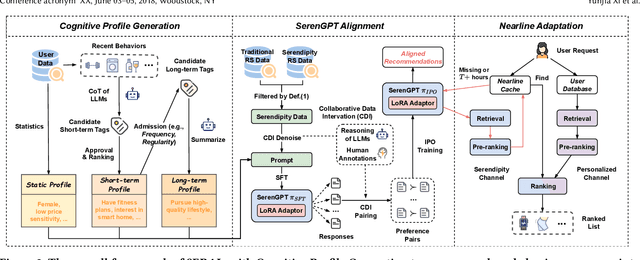
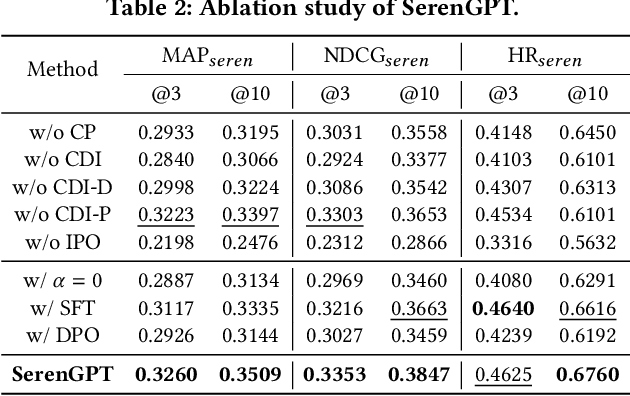
Recommender systems (RSs) often suffer from the feedback loop phenomenon, e.g., RSs are trained on data biased by their recommendations. This leads to the filter bubble effect that reinforces homogeneous content and reduces user satisfaction. To this end, serendipity recommendations, which offer unexpected yet relevant items, are proposed. Recently, large language models (LLMs) have shown potential in serendipity prediction due to their extensive world knowledge and reasoning capabilities. However, they still face challenges in aligning serendipity judgments with human assessments, handling long user behavior sequences, and meeting the latency requirements of industrial RSs. To address these issues, we propose SERAL (Serendipity Recommendations with Aligned Large Language Models), a framework comprising three stages: (1) Cognition Profile Generation to compress user behavior into multi-level profiles; (2) SerenGPT Alignment to align serendipity judgments with human preferences using enriched training data; and (3) Nearline Adaptation to integrate SerenGPT into industrial RSs pipelines efficiently. Online experiments demonstrate that SERAL improves exposure ratio (PVR), clicks, and transactions of serendipitous items by 5.7%, 29.56%, and 27.6%, enhancing user experience without much impact on overall revenue. Now, it has been fully deployed in the "Guess What You Like" of the Taobao App homepage.